Krsna Kirtana Songs est. 2001                                                                                                                                                      www.kksongs.org


Temple Room Deities
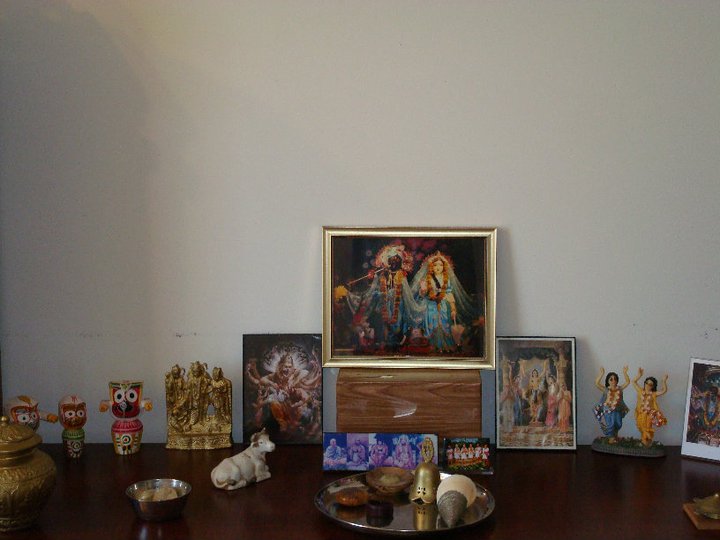


Hari Bol, visitors!


Welcome to my temple room altar! I have worshipped the personalities of this altar in almost this order from 1999 to 2001 and then from 2004 onwards.  (I was in
Buffalo from 2001 to 2004). From 1999, when I started an altar, it consisted with a simple Radha-Krsna picture with Sita-Rama-Laksmana Hanuman statue. Slowly, I started having more and more pictures of various personalities of the Lord. I printed out a picture of the Panca Tattva, guru parampara, Lord Nrsimhadeva, and Sri Nathaji. By Krsna's mercy, having Deities and an altar to worship was a wonderful experience and I wish to share this altar with you. For those familiar with proper Deity worship, this should not come as a surprise. If you are not familiar, here is a brief introduction with each personality.


Panca Tattva - Panca Tattva is a picture representing Lord Caitanya Mahaprabhu and His four associates. From the right side of Lord Caitanya Mahaprabhu (left side on the picture) is Nityananda Prabhu and Advaita Acarya. His left side (right side on the picture) is Gadadhara Prabhu and Srivasa Prabhu. Their pastimes are described in Krsnadasa Kaviraja's Caitanya Caritamrta. They are worshipped through many bhajans, but the most common mantra is the Panca Tattva mahamantra.


Lord Nrsimhadeva - This is the Lord most fiercest and ferocious incarnation. This is a form of half man-half lion. Lord Nrsimhadeva came to protect His devotee, Prahlada, when he was being tormented by his evil father, Hiranyakasipu. At the most critical moment, Prahlada thought of Lord Krsna and immediately Lord Krsna appeared in this form of Lord Nrsimhadeva! Lord Nrsimhadeva killed Hiranyakasipu with His nails. Demons fear Him the most, but devotees worship Him with great devotion. More of His glories can be found in the Seventh Canto of the Bhagavata Purana (Srimad Bhagavatam). There are many mantras and bhajans for Him, but the common one is the Nrsimha Pranams.


Sri Nathaji - Sri Nathaji is a Deity worshipped commonly in
Gujarat and in South India. It is a Deity showing Lord Krsna lifting up Govardhana Hill. Many songs and praises are sung in His glory. Sri Vallabhacarya, the father in law of Lord Caitanya and a famous acarya in South India, wrote an astakam offered to Srinathaji. It is known as the Madhurastakam.


Baladeva, Subhadra, and Jagannatha (not shown) - It is the Deity forms of Lord Balarama, Subhadra, and Lord Krsna. These are the forms which Lord Caitanya Mahaprabhu worshipped and these are the forms which are taken out of the temple to be placed on chariots and go across the city. This event, still being celebrated worldwide, is the Ratha Yatra.


Guru Parampara (middle last section) - The disciplic succession in which transcendental knowledge was passed down is worshipped in the altar. Usually, it is almost always the past five acaryas or spiritual teachers in the movement that are shown, although there have been thirty-three personalities that were a part of this succession including Lord Caitanya and His associates, Lord Brahma, Narada Muni, Vyasadeva, Madhvacarya, and Lord Krsna Himself. The five shown are from right to left:


Jagannatha Dasa BabajiSpiritual master of Bhaktivinoda Thakura.


Bhaktivinoda ThakuraSpiritual master of Gaura Kisora Das Babaji; Father of Bhaktisiddhanta Sarasvati Thakura. He is known for writing many essays in Sanskrit, Bengali, and English in order to preach Krsna Consciousness. He was the first to envision Krsna Consciousness to spread over the world.


Gaura Kisora Dasa BabajiDisciple of Bhaktivinoda Thakura and spiritual master of Bhaktisiddhanta Sarasvati Thakura. Bhaktisiddhanta Sarasvati Thakura was the only disciple Gaura Kisora Das Babaji ever had.


Bhaktisiddhanta Sarasvati Thakura – Spiritual master of Srila Prabhupada who ordered him to travel the West to preach Krsna Consciousness, author of many spiritual essays in Bengali and in English. He also wrote the Brahma Samhita in English. Under his guidance, sixty-four Vedic institutes, known as Gaudiya Mathas, have been established.


A.C. Bhaktivedanta Swami Prabhupada- Founder, acarya of ISKCON (International Society of Krsna Consciousness). Powerful exponent in the spread of Krsna Consciouness throughout the world and remains one of the most successful people in spreading the knowledge of Krsna.


The song that describes this succession in more detail can be found here in the Guru Parampara Bhajan.


Sita - Rama - Laksmana - Hanuman : These personalities came from the Ramayana. Sita is the eternal wife or Lord Rama. Lord Rama is the form of Lord Krsna in Treta Yuga to describe a model king and man, as well as to uphold dharma and kill Ravana, an evil tyrant king from Lanka. Laksmana is the brother of Lord Rama. Hanuman is below Laksmana always offering obeisances to all three. Hanuman represents the ideal servant of the Lord.


Radha Krsna (shown in many forms in the altar) - The most divine couple. Sometimes, Krsna is alone here, but when presenting Himself, He is always there with His beloved, Srimati Radharani. They are the most divine couple in all creation and worshipped with full of love from all of Their devotees.


Note: this photo’s main photo is of Sri Sri Rukmini Dvarkadhisa.

1