
Krsna Kirtana Songs
est. 2001 www.kksongs.org
Home
à Languages and Pronunciation à Bengali Guide
Lesson 6: Consonant Clusters 3
(Exceptions)
INTRODUCTION
The last lesson, despite a relatively
straightforward one, was a very difficult one. While the examples seemed fairly
easy, there might have been points which were overlooked. How would one know
that “ba” was supposed to bond with “ja” in the same way a typical Devanagari
letter would? How would one know when to put the second letter below the first
letter? While “kka (k + ka)” has a form of two “ka”
letters where was on the top and the other on top, why does “jja (j + ja)” produce a cluster
with both “ja” letters side? Even more confusing is
when a third letter is added to the jja mix, why does
it resort to a form where the first “ja” is losing
its “arm?” Unfortunately, there is no easy answer, but experience.
Experience will be built, but this chapter requires
solid memorization. Unlike Devanagari where there
were a few exceptions, this chapter will be filled with letters and mixes that
do not follow the general trend.
The first letter is the mix between “ka” and “ṣa” to form “kṣa.”
Figure 6.1 shows “kṣa” in a very unusual form.
Be sure to know this letter very well, because there is a letter that looks
very similar to the next letter in our discussion.
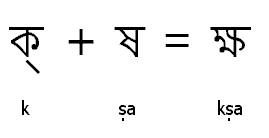
Figure 6.1
The letter that looks “kṣa”
is the mix of “ha” and “ma” to form the letter “hma.”
Notice the difference in the shape of kṣa and hma.
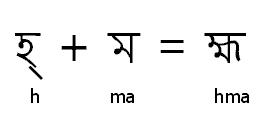
Figure 6.2
Double “ṭa” almost
adheres to the same process of stacking the letters on top of each other. The
only difference is that the second ṭa is not
really a ṭa. Figure 6.2A shows this.
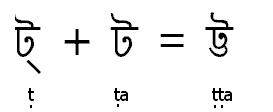
Figure 6.2A
CLUSTERS
WITH THE LETTER “ta”
The letter “ta” has many exceptions
in its formation of clusters. Let alone clusters, even the virama
form is quite irregular.
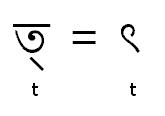
Figure 6.3
The letter “ta” mixes with
“ra” to form “tra.” Special
attention is needed for this letter. This is not like Devanagari
where a great majority of the letters has “lines above them.” In Bengali, there
are a good number of letters where the shape of the letter is the same, but the
presence of the line above them makes all the difference in the word. Without
the line above “tra”, the letter is changed to the
vowel “e.”
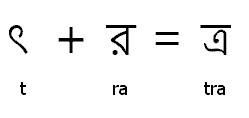
Figure 6.4
When two “ta” letters
combine, a new shape is formed. Again, pay attention to the line above the
letter “tta.” Without the line, it is the vowel “o.”
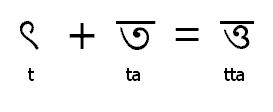
Figure 6.5
The clusters discussed up to this point can use any
vowel marking normally. However, when the vowel “u” is added
to any cluster that has the second letter being “ta”,
the “tu” takes shape of “tta.”
Look at Figure 6.6 when the mix of st and nt with “u” to form “stu” and “ntu” respectively.
These letters are not “stt” or “ntt.”
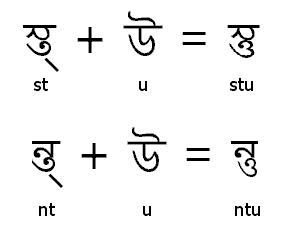
Figure 6.6
The last letter in our “ta”
subsection is the mix between “ka” and “ta.” The form
reminds us of “tta” with the right half of “ka.” This
is very odd because “ka” is the first letter of the cluster, but it’s on the
right. In addition, “tta” shape is used, even though
it is just one “ta”, not two.
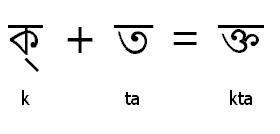
Figure 6.7
With the mix between “ka” and “ra”,
the “kra” letter looks like “tra”
with the right half of “ka.” Again, without the line, it might confuse a reader into reading “kra”
and “ai.” (Technically, the right arm of “ai” is different from “kra.)
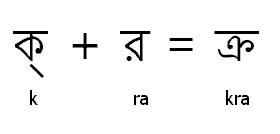
Figure 6.8
MIXES WITH
THE FORM OF “ña”
The last form of today’s discussion is the mix
between the form of ña. Why
the word “form” will be highlighted soon. The first cluster is the mix between
“ja” and “ña” to form “jña.” The form is shown by the left half of “ja”, with the right half of the letter “ña.”
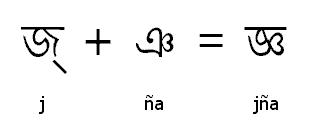
Figure 6.9
Lastly, the mix of ṣa
and ṇa requires special attention. The first
half of the letter ṣṇa is a full “ṣa” character, with the
“ṇ” take a strange form. Actually, it is a very strange mutation to form
the right half of ña.
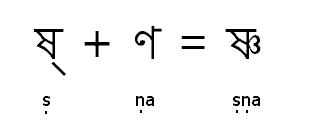
Figure 6.10
TABLE OF
CLUSTERS
When I studied Bengali in 2000, the first website I
encountered was ukindia.com’s Bengali reading
tutorial. Through the help of that site, I develop the basis of being able to
read Bengali. However, consonant clusters are indeed a challenge to master.
After reading the Caitanya Caritamrta’s
Bengali verses, I began to pick up the general forms of compounding consonants.
A special table was made on that site. I modified it to be relevant to the last
three chapters. Always note, there may be exceptions.

Figure 6.11
1: This form of k is used for kta
and kra.
2: This form is used as a “ña”
symbol for the letter “jña”. This form is used as a “ṇa” symbol for the letter
“ṣṇa.”
3: This form is tu for a consonant
cluster with a full ta. This is not tta.
PRACTICE:
Try spelling these words using Bengali Script:
1. kṛṣṇa
(Lord Krsna)
2. kīrtana
(chanting of the Lord’s name)
3. bhakti-yoga (devotional
service) *use the “ja” form of ya.
4. yajña
(sacrifice)
5. lakṣmīpriyā
(Lord Caitanya’s wife: Laksmipriya)
6. karuṇā
sindhu (ocean of mercy)
7. brahma-saḿhita
(Brahma Samhita)
8. kṣatriya
(warrior-administrative class)
9. prahlāda
(Prahalada Maharaja)
10. nāma-haṭṭa
(The storehouse of the Lord’s name)
Try reading the words from Bengali script.
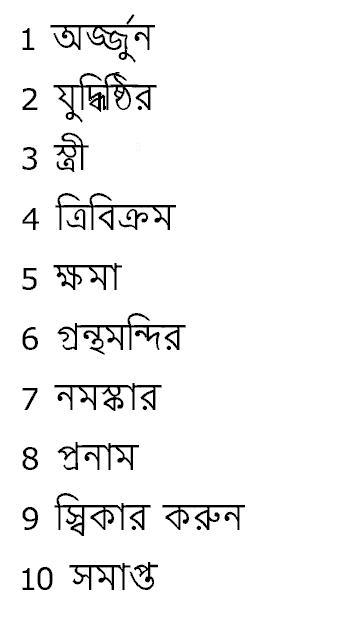
UPDATED: June 16, 2009