
Krsna Kirtana Songs
est. 2001 www.kksongs.org
Home
à Languages and Pronunciation à Bengali Guide
Lesson 3: Reading Vowel Markings
INTRODUCTION
In Lesson 2, examples of words with letters with an
“a” sound without any other vowel use were looked at. Just like the Lesson
VIRAMA
(HALANT)
For the consonants of the Bengali alphabet, each
letter is presented as a mix of a consonant with a short “a” sound. However,
when the “a” sound is dropped, then all we hear is just the consonant without
the vowel sound. For instance, “ka” without the “a” sound = “k.” To cut the
vowel sound out of a consonant, a special symbol is added beneath a letter
known as a virama (some refer to this as the halant).

Figure 3.1
To stress the importance of the vowel’s presence in
the letter, the “a” sound is emphasized. Each consonant of the Bengali alphabet
is originally a letter with a virama which “a” added
to produce the letter.
VOWEL
MARKINGS
All vowels (except “a”) has a representative mark
made to add onto consonants. Whenever a consonant makes use of a particular
vowel, it adopts the representative mark of the vowel. Figure 3.2 shows the
listing of the vowel markings of the vowels.

Figure 3.2
To make practical use of this, Figure 3.3 will show
how each consonant has a virama added to it. With the
help of the particular vowel, the consonant receives the sound of the vowel added.
Looking at the letter “ka,” notice how the vowel addition yields the vowel
marking.

Figure 3.3
Remember, it is the consonant with the virama that gets the vowel marking. If you add the actual
letter (the letter that ends in short “a”), you do not get a vowel marking, for
it is interpreted as two syllables. Figure 3.4 shows this.
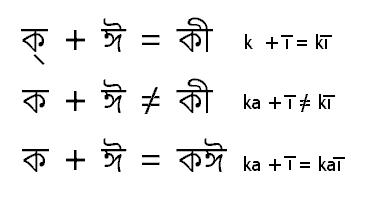
Figure 3.4
The process for adding vowel markings applies to all
letters. There are a few exceptions which will be discussed later.
SPELLING
WORDS USING THE BENGALI ALPHABET
Just like the last lesson, we will first learn how
to write words. However, since the process is the same as Devanagari
words, only one example will be studied.
EXAMPLE
1: “kebala” (only [Bengali]).
STEP 1:
Break the word down through its syllables.
There are three syllables in this word: “ke”, “ba”, and “la.”
STEP 2:
Find the letters of the word and examine which vowels belong to each letter.
Recall the letters for “ka”, “ba”
and “la” on the Bengali alphabet. See which vowel follows the original word.
You will see that both “ka” have the vowel “e” following them. Letters “ba” and “la” have no vowel signs (that is “short a”). Place
the vowel markings appropriately.
STEP 3:
Put the letters with vowel markings in order to form the word
The entire process is shown below in Figure 3.5
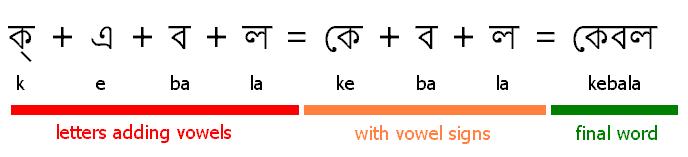
Figure 3.5
TRANSLITERATING
WORDS INTO BENGALI
The steps of transliterating words are exactly the
same as the steps shown in Lesson 2 as well as the technique shown in Devanagari.
Therefore, only one example will be examined.
EXAMPLE 1:
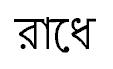
Figure 3.6
Break all
letters down. Each letter is one syllable long.
This is done in Figure 3.7.
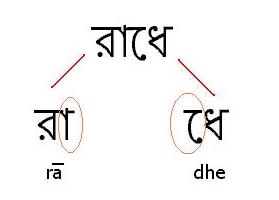
Figure 3.7
Pay attention to the vowel markings highlighted in
orange in Figure 3.7. From the two vowel markings, a long “ā” and a long
“ī" is present.
STEP TWO:
Identify the letters in order
STEP
THREE: Convert them into the transliteration scheme and say the word.
Finally, “rā” + “dhe” = “radhe.” (Another name of Radha)
EXCEPTIONS
IN VOWEL MARKINGS:
Unlike the Devanagari
alphabet (there were two exceptions: “ru” and “rū”), the Bengali alphabet has more exceptions. The “ru” and “rū” are also
exceptions in Bengali. In addition, “gu”, “śu”, “hu”, and “hṛ”
are exceptions. Figure 3.8 shows they look like. Some software that function in
transliterating Bengali will not have gu, śu and hu in its special and
correct forms, because it will be seen that a greater number of characters will
be needed to represent Bengali words properly. The “exceptions” can be
understood without trouble, but not the other letters.
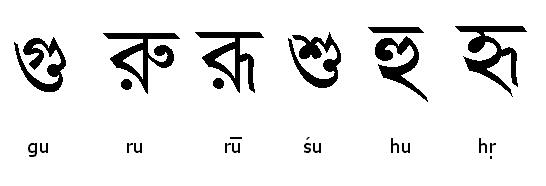
Figure 3.8
The font change came from www.ukindia.com Bengali
Reading Guide. It is a great guide to look for reference too.
AUTHOR’S
NOTE:
“Since my software can’t produce every letter in Bengali, please forgive
me in this shortcoming. To dedicate those six exceptions, try transliterating
the ones in the practice.”
When we start consonant clusters, watch me start my
flusters!” –Krsna Dhenu
PRACTICE:
Try spelling these words using Bengali Script:
1. ghṛnā (hate
in Bengali)
2. puruṣa (man in
Sanskrit)
3. dhānī (Raga Dhani in North Indian music)
4. mākhana-cora
(“Butter-Thief”)
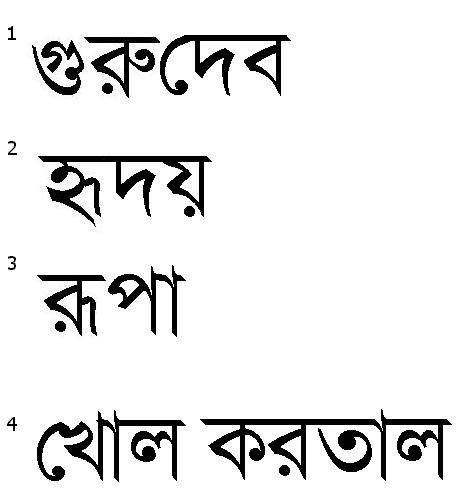
Try reading the words from Bengali script.
UPDATED: June 16, 2009