
Krsna Kirtana Songs
est. 2001 www.kksongs.org
Home
à Languages and Pronunciation à Bengali Guide
Lesson 4: Consonant Clusters 1 (Anusvāra and Nasal Elements)
INTRODUCTION
This is indeed the most daunting chapter to teach
and this is the toughest lesson for the Bengali studying student. This is the
ultimate reason why Devanagari study was recommended.
Event though the ultimate conclusion will be made that Bengali’s process of
mixing letters is different than Devanagari, the
prerequisites of learning how to derive half-letter forms and how to mix
accordingly will have a role to play in the next few chapters.
Remember, a consonant
cluster is a mix of consonants to form one sound. Remember, if two letters
are being mix, the first letter always has a virama
applied.
TABLE OF
NASAL ELEMENTS FOR EACH MAIN ROW

Figure 4.1
Normally, I don’t advocate grand memorization unless
it is needed. This table is one of the few that will need such memorization.
There will be one more table that will require memorization later on. Unfortunately,
there is no real way of telling when a half-form is used or not. For example,
the “ńa” mixes with the gutturals in a somewhat
random fashion. The letter “ńka” is easy to
decipher the “ka.” No obvious sign of “ńa” is
present. The letter “ńkha” has the “ń” and
“kha” which are quite obvious. The letter “ńga” has a form which neither resembles “ńa” and “ga.” To matters
more confusing “ńgha” looks like “ńkha”, though there is no real connection between ńa and gha.
If one takes the time, one will make patterns for the palatals, cerebrals,
dentals (this should be the easiest one), and labials (the most obvious one).
TWO
ANSUVARA TYPES:
As mentioned before, the transliteration scheme is
inconvenient, for this is optimal for Sanskrit only. However, as many
authoritative academic books use the Sanskrit transliteration for all Indian
languages, KKSongs.org resorted to this method, even though there are
inaccuracies in spellings. Figure 4.2 shows the two types of anusvāras that is found in the Bengali language.
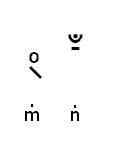
Figure 4.2
The sound “ḿ” has the same function as Sanskrit, but a very
different pronunciation. The “ḿ” letter is pronounced as “ng” in Bengali. For example, the word “evaḿ”
is pronounced as “eh-bawng.” “Oḿ” is
pronounced “ong.” From the Srimad
Bhagavatam, the evil king, “Kaḿsa”
is pronounced “kawngsho.” This mark is treated as a
letter, even though it is not really a letter.
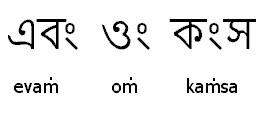
Figure 4.3
The sound “ń” is not the same thing as the
letter “ńa” from the gutturals. The “ń” is
a very strong nasal which sounds similar to the Sanskrit “ḿ.” For
example, “gaura-cāńda” is pronounced is as
“chaand” with the “aa”
sound coming from nose. The word “ṣańřa”
is pronounced as “shaař” with as strong nasal on
the “aa” sound. “The ń is placed on top of the
letter.
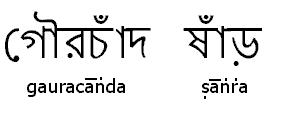
Figure 4.4
PRACTICE:
Try spelling these words using Bengali Script:
1. mańgala
(auspicious in Bengali)
2. andhakāra
(darkness in Bengali)
3. pāñcālī
(Daughter of the king of Panchal Draupadi)
4. bāńśi
(flute in Bengali)
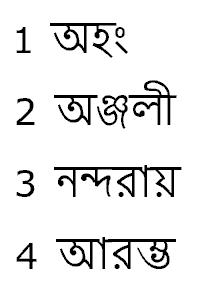
Try reading the words from Bengali script.
UPDATED: June 16, 2009