
Krsna Kirtana Songs
est. 2001 www.kksongs.org
Home
à Languages and Pronunciation à Bengali Guide
Lesson 5: Consonant Clusters 2
(General Forms)
INTRODUCTION
This is the heart of the Bengali Reading Guide. After
completing this chapter, nearly 70% of Bengali words will be readable. Before
entering deep into this chapter, it is advisable to review the Devanagari concepts of mixing consonants. For most Devanagari letters that had the stick
form, compounding was quite simple. One would remove the “stick” off the first
letter, thus producing the half-letter
form. Then, one mixes the half-letter form with the full form of the next
letter to form the cluster.
In Bengali, there are a few letters which do follow this Devanagari
form. For example, the letters “ba” and “ja” in Figure 5.1 forms a cluster which has a “half-form”
of ba with the full form of ja.

Figure 5.1
MOST
COMMON CLUSTER-FORM
Most consonant clusters are formed by placing the
first letter above the second letter.
For example, “sa” + “ba”
can form “sba” for words like “svāmī”
(remember, in Bengali, there is no “v” letter, so “b” will replace all “v”
letters in Bengali). Pay attention to the red letter “sa”
and green letter “ba” and see how they snap together
in Figure 5.2
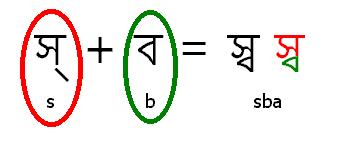
Figure 5.2
Remember from Lesson 4, the nasal form for the mix
between “na” and “ta” to
form “nta.” The concept is verily the same.
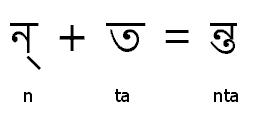
Figure 5.3
Here is a mix of two “ka” letters.
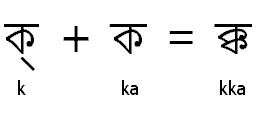
Figure 5.4
Two “da” mixes like this
in Figure 5.5
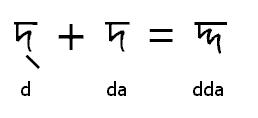
Figure 5.5
SECOND
LETTER FORMS
As this process is quite straightforward, there is a
catch to this process. With the exception of the letter “ra”
and clusters that took different forms in Devanagari,
the second letter had always retained its form. In Bengali, that is not the
case. In Bengali, there are many letters which are “second-letter” forms. The
most common ones will be studied here.
The mix between “ma” and “ya”
is an example of a letter that uses a second letter form. Since “ya” is the second letter, by the nature of the letter “ya” uses the second letter form. Figure 5.6 shows this. It
almost seems like the second-letter form of “ya” is
like a vowel marking. For one who can only read Devanagari,
no one would have guessed that the marking to the right of “ma” (which is
really an “m”) was a full “ya.” When pronunciation is
studied later on, one will see that the mix of any letter with “ya” produced an unusual sound in Bengali.
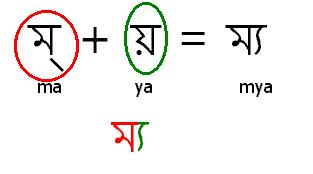
Figure 5.6
The letter “dha” also has
a second-letter form. In the mix of “ga” and “dha”, the letter “dha” adopts a
special form that remotely looks like “dha.” For the
most part, anytime dha is a second letter, it’ll
adopt this form. It’ll cling onto stick or the tail of the first letter. Recall
from Lesson 4 on writing the letter “ndha.” Note how
“na” retained it full letter form (even though it is
theoretically a “n”), but adopted the second-letter
form of “dha.”
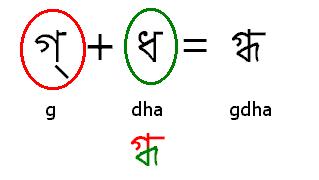
Figure 5.7
Letter “ma” has a special second-letter form. Unlike
“dha” and “ya”, the second
letter form has a look which one can easily tell that it came from the letter
“ma.” For example, “sa” + “ma” is “sma” is shown in Figure 5.8. Also, notice the “half-form”
of “sa” on top.
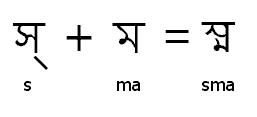
Figure 5.8
To conclude this lesson, it is quite useful to talk
about the letter “ra.” The letter “ra” has a different half-form and different second-letter
form, just like Devanagari. Before discussing it in
detail, it is important to look at Figure 5.9.
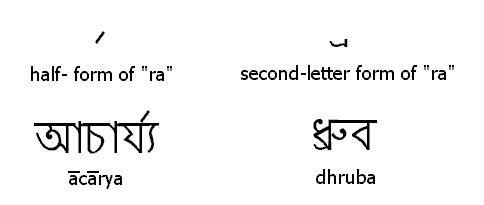
Figure 5.9
The half-form of “ra”
(which looks like an accent mark) is placed on top of the second letter. This
is just like the “half-form of ra” rule shown in Devanagari. Note the difference between in the Bengali spelling
and transliteration of the word “ācārya.”
In Bengali spelling, it is spelled “ācārjya.”
Usually, the consonant following half-letter “ra”
ends up being doubled. For example, “kirtana” becomes
“kirttana”, “dharma” becomes “dharmma",
“karma” becomes “karmma" and so on. The detail
on why this happens is described in the pronunciation chapter of this guide.
The second-letter form of “ra”
is attached to the bottom of the letter, whether it is a letter with a stick or
not. Since “ra” is really the full letter, “ru” and “rū” exceptions
mentioned in Lesson 3 apply here. In Figure 5.9, the word “dhruba”
has the letter “dha” (technically “dh”) mixed with
the second letter form of “ra” to form “dhra.” Since the vowel “u” applied to the “dhra” (with the ra), the special
form of “ru” is used.
There are more consonant clusters to discuss, which
incredible exceptions that will perplex the inexperienced reader. Therefore, it
is absolutely imperative to study this chapter and practice on these exercises.
PRACTICE:
Try spelling these words using Bengali Script:
1. nitya
(eternal in Bengali)
2. tṛpti
(satisfaction in Bengali)
3. prabhupāda
(lit. Lord’s feet, or name for a spiritual master, or Srila
Prabhupada)
4. dugdha
(milk in Bengali)
5. śyāmasundara
(name for Lord Krsna)
6. viśvambhara
(another name of Lord Caitanya)
Try reading the words from Bengali script.

UPDATED: June 16, 2009