
Krsna Kirtana Songs
est. 2001 www.kksongs.org
Home
à Music Center à Instrumental Guides à Harmonium Guide
Chapter 08: Review
A great deal of very important information dealing with
the basics of Indian music was discussed here. Let’s take the opportunity to
review them.
The keyboard of the harmonium has a set of three
fundamental units of keys. The fundamental unit is shown in Figure 8.1.
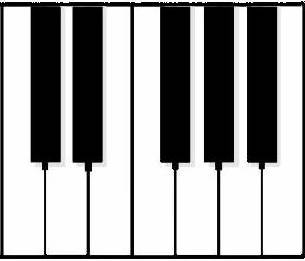
Figure 8.1
This structure of any keyboarded instrument has this
fundamental unit repeating over and
over again. In harmonium, it usually has three repeating patterns.
We discussed a little later that a fundamental unit
is a scale, which consists of seven notes. Once eight
notes (7 notes + starting note of the next fundamental unit) are completed, it
is known to have completed one octave
in Western music, or a saptak
(seven notes) in Indian music. Figure 8.2 shows the scales and octave vs. saptak comparison.

Figure 8.2
In understanding the relationships between any two
notes, we talk about half steps and whole steps. The half step is one-key
difference from the first note. A whole step is a two key difference. The
half-step is the smallest unit of measure in describing distance between two
notes. Look at this diagram and recall from Chapter 5 that half-step does not always mean from a white to black (or
vice versa). Likewise, whole-step does not imply a white-to-white (or
vice-versa) relationship. The red bracket is the half-step, while the blue is
the whole-step.
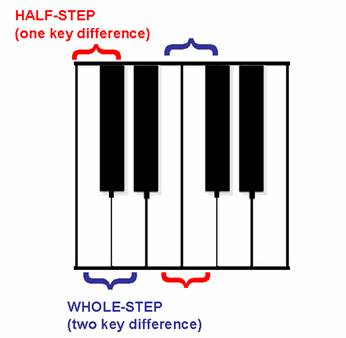
Figure 8.3
The three saptaks in a
typical harmonium is shown in Figure 8.4.
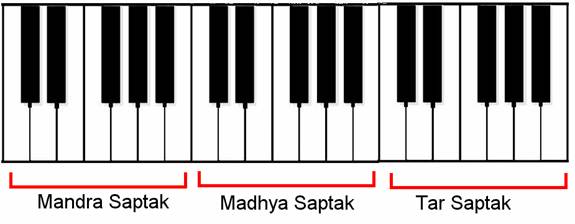
Figure 8.4
Then, the discussion of the seven notes were
described, the notes were sa, re, ga, ma, pa, dha,
and ni.
They can be abbreviated as S, R, G, m, P, D, and N. They are known as suddha swars and
can be represented by white keys. The semi-tones between some suddha swars, are known as vikrta swars, and
are known as komal re, komal ga, tivra ma, komal
dha, and komal ni. They are abbreviated as r,
g, M, d, and n. The overall sargam, or collection of notes, are shown below on Figure
8.5

Figure 8.5
Figure 8.6 shows these notes in the eyes of the
entire harmonium bearing the madra, madhya, and tar saptaks.
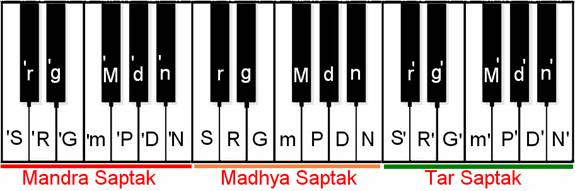
Figure 8.6
Lastly, here are the ten thats Visnu Narayana Bhatkhande developed.
Asavari
S R g m P
d n S’
Bilaval: (the major scale that we worked with)
S R G m P
D N S’
Bhairava:
S r G m P
d N S’
Bhairavi:
S r g m P
d n S’
Kalyana:
S R G M P
D N S’
Khammaja:
S R G m P
D n S’
Purvi:
S r G M P
d N S’
Marwa:
S r G M P
D N S’
Todi:
S r g M P
d N S’
Unless you have developed full knowledge of the material,
do not move onto the next unit. The next unit will develop on more theoretical
applications which cannot be understood easily without understanding this
material first.
UPDATED: June 18, 2009