
Krsna Kirtana Songs
est. 2001 www.kksongs.org
Home
à Music Center à Instrumental Guides à Kartal Guide
Lesson 9:
Accompaniment Etiquette
Now
that cycles and accompaniment have been formally taught, there is one more topic
that needs to be discussed. There are three major instruments that survive
alone, musically. The kartals fits this category,
because there is no possibility to make a melody through cymbals. In addition,
it does not have many bols, which prevents it from
earning the reputable status of being a solo percussive instrument, like the tabla. Therefore, the kartals can
only serve as accompaniment. Despite having such limitations, the kartals can be one of the most important instruments. The
singer, mridanga or tabla
player, and the audience can rely on your kartal
rhythm to the point that no one should grossly fall off place. In order to be
an efficient and effective kartal player, some
behavioral etiquette rules should be observed.
1. You are only accompanying an
singer, musician, or artist
When
you play the kartals for someone else, you must
remember that you are being there to help the singer or the main artist. In
some cases, you may have very talented musician-devotees that have great
experience in kirtanas, bhajans,
or whichever musical form or dance they want to render.
-
Play in such a way that the main artist does not get drowned out or you play in
a way contrary to the needs of the kirtan. You are
there to help the artist, not help promote your talent.
-
As mentioned earlier, kartal cannot survive alone,
musically. However, just because mridangas,
harmonium, and other instruments are playing does not give one to right to
attempt a “kartal solo.” Stick to the cycles that you
think will positively help the artist and will help him or her from going
astray.
-
Stick to the tempo alone. If the singer or main artist wants you to speed up,
they will give you a subtle cue, like stare at you constantly, start pumping
the harmonium loudly, or play harmonium faster.
2. Predict the tala
that is being played
Even
though in the temple, most of the kirtanas will be in
eight matras, you might want to listen to one mahamantra before you decide which set of rhythmic cycles
you will need (i.e. Will four or three beat cycles be
used?). Count out the beats mentally before playing. Always try to match the sam of the previous chapters to the sam
of the song. Sometimes, clapping to the song would help keep track where the
beats fall.
3. When playing, focus only tala, tempo, and the main artist
It
is very easy for new students to easily miss a beat, for various reasons. If
you think you may have missed a beat, look at the artist and stop playing and
find the point where you can pick up and play on time. If you are really lost
on what part of the cycle you should resume playing, try to pick up on a point
where you can start off at the first beat of the kartal
cycle.
If
the main artist asks you to accompany a rhythm you are not 100% comfortable
with or do not know how to play kartals for, humbly
notify the artist that you are unable to play that.
4. Loud is never good
When
people play kartals for the first time, they will
tend to get overly excited that they will play the kartals
too loudly, to the point that kartals begin to sound
cacophonic. Instead of side-rhythm and help, it becomes a loud disturbance.
Therefore, don’t play too loudly and forcefully. Even in fast rhythms, playing
gently and normally would help the ecstatic singer and mridanga
player focus on the rhythm nicely.
5. Whompers
are NOT kartals!!!
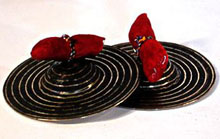
Figure
9.1
For
those who are not familiar with whompers, they are large version of kartals.
They are actually known as garba jhanjh. While the kartal’s
diameter ranges from 3 to
This
comes at a price, though. People assume that these are played like kartals, and as a result, an obnoxiously loud sound comes
about creating more of a disturbance than real accompaniment. Plus, it can
cause kirtans to reach or exceed safe hearing levels,
which result in devotees going partially deaf later on in life, or devotees
wearing earplugs.
As
a result, many temples either stop carrying whompers
or have designated people playing them. If your temple does not have such
rules, please keep in mind that whompers are not kartals! You cannot play the cycles that were discussed in
this course. The whompers should be used to mark the sam only.
6. Use good judgment
Most
of the time, a kirtan leader will not coordinate in
advance who will play kartals, harmonium, and mridanga and in what tala. If the
kirtan leader wants to speed up, speed up gradually.
Don’t speed up abruptly. Same thing with slowing down too! Likewise, do not use
the faster speed kartal cycles for slow songs. You
can, however, use the slow cycles for fast songs, as they will function for
marking rhythm in a tasteful manner.
UPDATED: June 23, 2009