
Krsna Kirtana Songs est. 2001 www.kksongs.org
Home à Music Center à Instrumental Guides à Khol Guide
Lesson 2: Dayan Bols
INTRODUCTION
Throughout time, education in India was executed
through the system called gurukula. The gurukula (lit. “family of guru”) system was a system of apprenticeship and
disciples. A student seeking knowledge goes to the guru’s house in search for
knowledge. The eager student serves the guru in many ways, while the guru takes
care and provides for his or her needs. After the guru is satisfied with his or
her service, the guru gives knowledge to the student. This system, although not
as prevalent, is found in some places today.
Music was taught in this manner. However, they did
not have books, notebooks, sheet music, tape recorders, or the internet to
record the guru’s teachings. Everything was done strictly through memory. In
order to assist memory in learning percussion instruments, bols were taught. A bol is a syllable that is used to describe a sound produced
by a drum. The word “bol” literally means to “speak.”
(Like “Hari Bol” means
“Speak the name of Hari!”) Music philosophers would
often say that the instrument is speaking when played properly. People tend to
use the word mantra in place of bol, but it is not
preferable to interchange. Bols are more specific,
while mantra refers to an incantation, rather then minor syllables. Hence, we
will discuss mridanga bols
and khol bols, not mantras.
This week we will examine dayan bols. There are
actually a good number of bols that are on the dayan, but only a few will be
examined.
RESONANCE
VS. NONRESONANCE
Resonant sounds are sounds that are open and full
of sound emanating from the puri. Nonresonant
sounds are closed sounds with minimal or no sounds that emanate from the puri. In looking at the dayan bols, there will be
two open bols and three closed bols.
OPEN BOLS – Full of resonance
tā
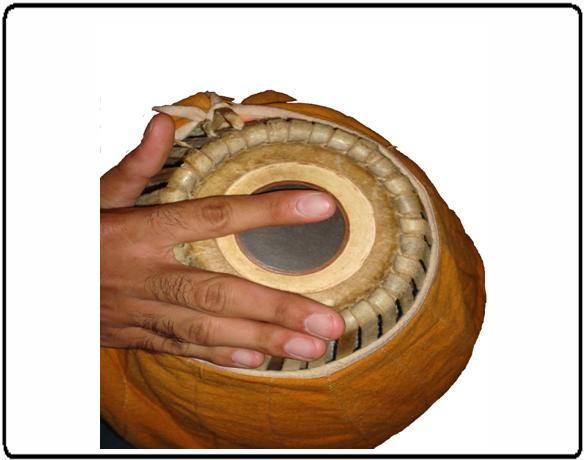
This bol is played by taking
the index finger and striking the dayan
on the syahi or maidan and syahi border. This is one of the most fundamental sounds
that is found on the khol.
This bol can almost dictate whether one can produce
clean and resonant bols. This bol
should sound nice and resonant. Be sure to loosen fingers and allow an attack,
as stiff fingers will produce a partially resonant to a nonresonant
sound. The fingers should effortlessly bounce back up.
Click on the puri to
hear how tā sounds like.
nā

The nā
bol is played by striking the kinar.
This should be produce a sound very similar to tā,
but softer. Click on the puri to hear the sound of
the nā bol.
CLOSED BOLS – Lack of resonance
tī

This bol is a closed
one: It is played by taking the middle, ring, and pinky fingers and striking
the syahi with the maidan
and kinnar along the way. Very little resonance
should come out from the puri. As the photo shows,
the fingers are striking towards the bottom half of the puri.
Listen to the audio clip on the puri and hear how ti is played.
ra
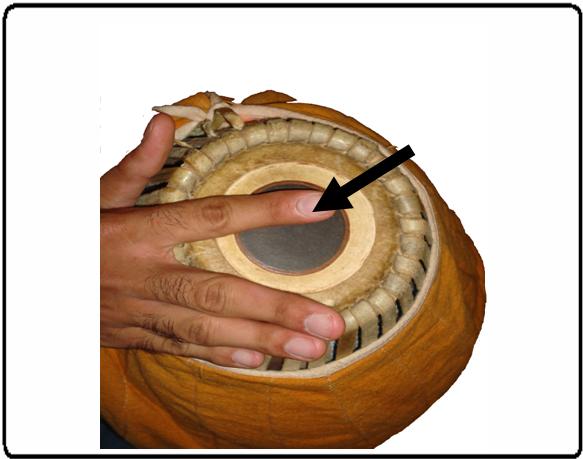
The bol “ra” is a very tricky bol, but for
the scope of this course, it is best described as a transition from “ti.” As you simultaneously remove the three “ti” fingers off, take the index fingers and strike it
off-center the syahi to the left of the “ti” position. You will see that this bol
is a closed one: It is played by taking the index finger and striking the syahi slightly off-center. Be sure not to go too far off
the syahi that it almost enters maidan
territory. While “ra” is commonly played after “ti”, the “ra” should be easily
produced independently.
te
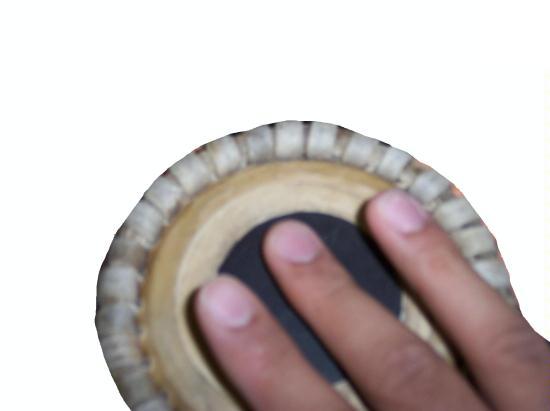
This one is not used too frequently, but I
included it here for completion sake.
This is just like ra,
except it is with the middle finger on the center of the syahi.
The index and ring fingers are sticking up. This should produce one of the most
nonresonant sounds on the khol.
Practice with listening and playing te.
Then compare all of the nonresonant sounds to hear
subtle differences. Due to the way your khol was
made, some of the subtleties may not be heard that well.
·VIDEO CLIP 2 – 1: Lesson 2 DIDACTIC
It is only useful to test what you know. Here are
small clusters of bols to get you some practice.
1. ti ra ti ra (It
helps to rotate the wrist when changing bols from ti to ra)
2. ra ti ra ti (just
the opposite of “ti ra ti ra”)
3. ti tā
ti ra
(The playing technique is the same as “ti ra ti ra”,
but you replace the ra with tā.)
4. tā tā
ti
·VIDEO CLIP 2 – 2: Lesson 2 PRACTICAL
UPDATED: November
27, 2013