
Krsna Kirtana Songs est. 2001 www.kksongs.org
Home ⇒ Music Center ⇒ Instrumental Guides ⇒ Khol Guide
Lesson 3: Baya Bols
Lesson 2 introduced to the concept of the bols. We examined the world of dayan bols. Today, we will examine baya bols. Recall from Lesson 1 that the baya is the bass drum.
CLOSED BOLS – Lack of resonance
ka
This is the general term given to a closed baya bol. Generally, it is done by taking the full hand and striking the baya head causing no resonance. The general concept of this bol is quite simple. There are three types of ka bols.
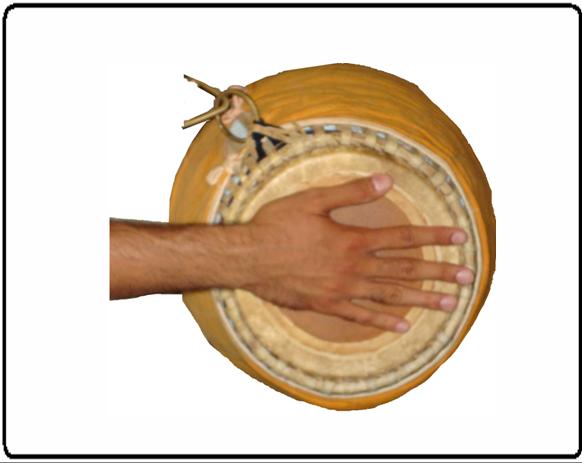
Soft ka – The method shown above describes a soft ka. The full palm covers the puri as shown above.

LOUD KA
Using the “rotation” motion that was discussed in Lesson 2 with “ti”, supinate the hand inward using the knuckles (second set) and strike the center of syahi causing a loud “crack” sound. If you can’t use the second set, then the first set is also fine.
Finger ka – Cuff the palm, as if you were to do the cobra position of the “ga/gin” bol (see bol below) and flick the maidan or syahi (kinar is fine, though it doesn’t produce a strong sound). LISTEN
This rendition of ka is optional for this course.
OPEN BOLS – Full of resonance
gha
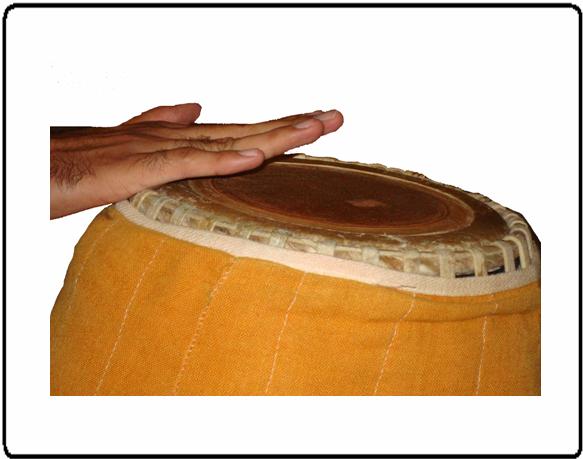
This bol is created by taking the baya hand and striking the syahi causing a loud bass sound. This is by far the most popular open bol that is heard in mridanga. It is very important to be able to have a strong bass sound that sounds clear and free from any symptoms of non-resonance. Listen to this bol by clicking on the puri.
ga

This is a softer version of gha. It is played by placing the wrist on one end of the syahi and striking with the index or middle-ring fingers on the maidan opposite to the wrist. Only middle finger is not preferred as it will hinder baya hand sound control. The ring finger alone is too weak to produce a strong ga sound. Remember that the ga is a open sound, but it is not meant to be as loud and powerful as gha. Compare ga with gha by listening to the sound files.
This is an optional bol for this course.
gin

This bol essentially a sliding ga. Sliding across the syahi causes the pitch on the baya to change. This bol is done as a simultaneous act of playing ga with the fingers and sliding the wrist across the puri of the baya. For those new to the khol, it becomes a very difficult task to produce a clean sound. To master this bol requires constant practice.
The best way to practice this, initially, is to play ga and then slide constantly. Then, a smooth transition will come where it becomes simultaneous.
This bol is also known as jin.
This is an optional bol for this course.
VOWEL TOLERANCE
For dayan bols, each bol has one unique name. For example, tā is always tā. Changing the vowel to te or ti will imply two different bols. This is not the case in the baya bols, however. In the baya bols, there is a great deal of vowel tolerance. A reason for this may be due to the fact that baya bols are very much prone to pitch fluctuation. In order to represent them, musicians will say the bols and often change the vowels of the baya bols to show how much of a pitch fluctuation is required. Pitch fluctuation was more of an aesthetic property rather than a required property. In fact, this khol course will hold up to the same standards of the gin bols being an aesthetic property. First, rhythms should be studied. Then the aesthetic gins may be added. For now, just learn the bols independently, for now. And also remember that dayan bols show little tolerance. Baya bols, however, show great vowel tolerance.
ga = ge = gi
gha = ghe = ghi
ka = ke = ki
Unlike Lesson 2, there is no “practical” part to this lesson quite yet. It will be demonstrated, along with Lesson 4 practice in Lesson 5.
·VIDEO CLIP 3 Lesson 3: Baya Bols
UPDATED: August 16, 2017